
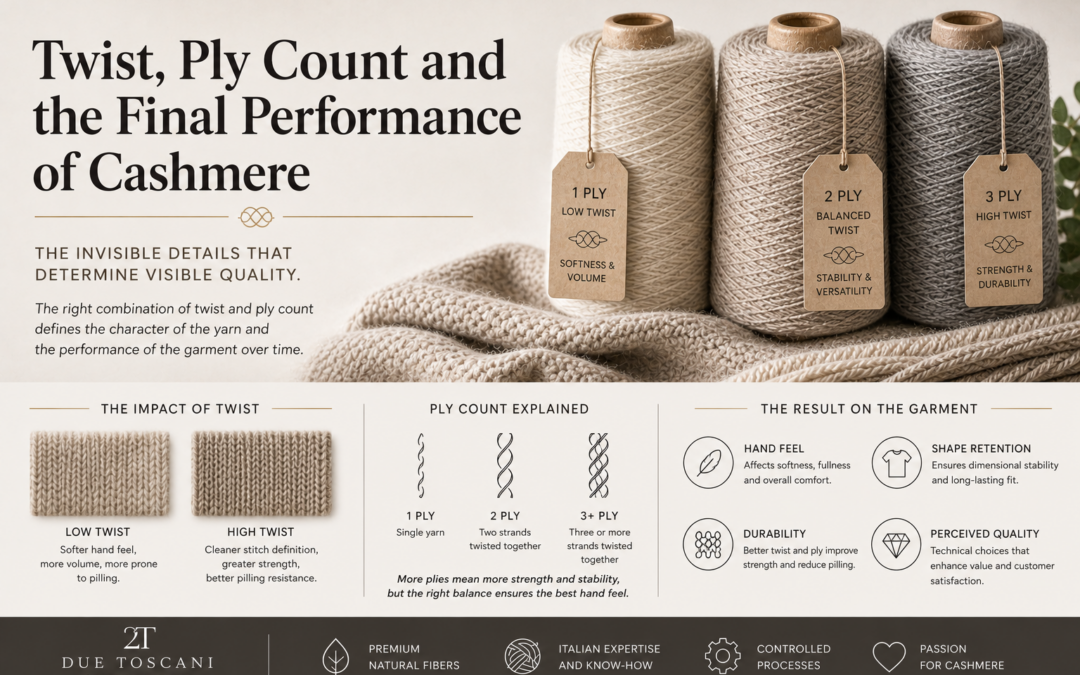
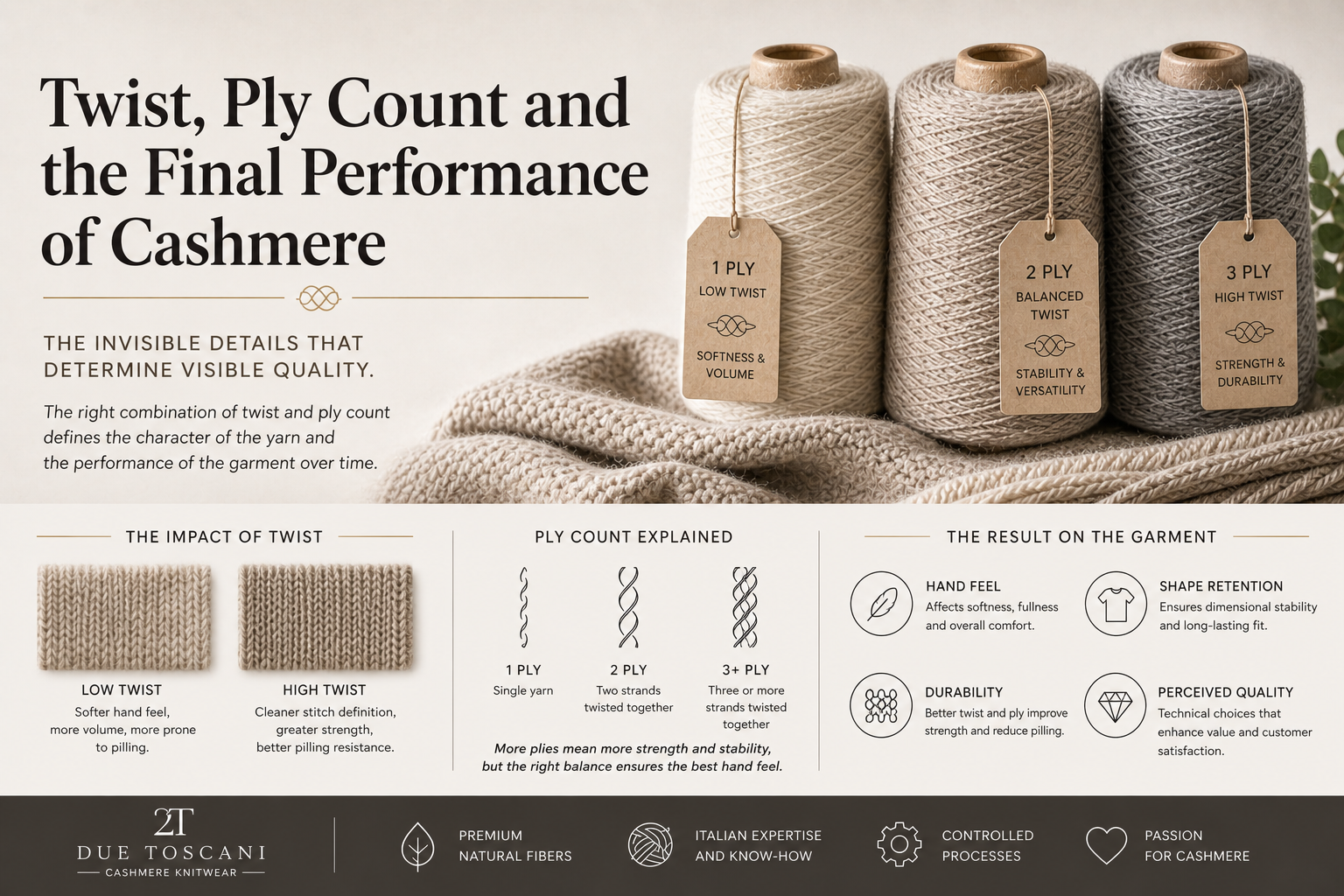
In the world of cashmere knitwear, there are technical parameters that rarely reach the final customer, yet directly determine the quality, performance, and perception of the product. Among these, yarn twist and ply count are two fundamental elements, often underestimated but essential for anyone operating in B2B. These are not minor details, but true design variables that influence the hand feel of a garment, its stability, its durability, and, just as importantly, its commercial positioning.
For Due Toscani, working with cashmere means deeply understanding these aspects and integrating them from the earliest stages of product development, because this is where the difference is created between a garment that performs well and one that creates problems over time.
What Yarn Twist Is
Twist is the process by which fibers are rotated around themselves to form a continuous yarn. It is what gives cohesion to the fiber, transforming a discontinuous mass into a usable thread for knitting.
However, twist is not a fixed parameter. It can vary in intensity and direction, and each variation produces concrete effects:
- low twist results in a softer, bulkier, more open yarn
- high twist creates a more compact, stronger, and more defined yarn
Twist is the first factor that determines the character of the yarn.
What Ply Count Really Means
When we speak of multi-ply yarns, we refer to the number of individual strands twisted together.
- 1 ply → single yarn
- 2 ply → two strands twisted together
- 3 or more plies → more complex structure
In cashmere, ply count directly affects:
- yarn strength
- garment stability
- long-term performance
A multi-ply yarn is not necessarily better, but it is more controlled and predictable.
Twist and Ply Count: A Balance
Twist and ply count cannot be considered separately. The final result depends on their combination.
A 2-ply yarn with balanced twist:
- maintains softness
- improves stability
- reduces deformation
A single-ply yarn with low twist:
- is extremely soft
- but more delicate and less resistant
Quality comes from balance, not extremes.
Impact on Hand Feel
The hand feel of cashmere is one of the most important aspects for the end customer, and twist and ply count influence it directly.
- lower twist → softer, more open feel
- higher twist → drier, more compact feel
Similarly:
- more plies → more structured and stable sensation
- fewer plies → lighter and more fluid feel
The tactile perception is always the result of precise technical choices.
Impact on Durability and Pilling
One of the most critical aspects of cashmere knitwear is pilling, the formation of small fiber balls on the surface.
- low-twist yarns tend to pill more
- well-twisted, multi-ply yarns resist pilling better
This is because the fibers are more firmly anchored within the yarn.
A well-constructed yarn improves garment durability.
Behavior in Production
From a production perspective, twist and ply count influence:
- yarn flow in the machine
- stability during knitting
- stitch definition
A yarn that is too soft may:
- break more easily
- create irregularities
A yarn that is too tightly twisted may:
- lose softness
- feel less like true cashmere
Again, the difference lies in balance.
Impact on Price
Twist and ply count also affect the final cost.
- more plies → more processing → higher cost
- controlled twist → more precise production → higher quality
However, the value is not just in cost, but in performance:
a well-built yarn reduces production issues, returns, and customer dissatisfaction.
The Case of Recycled Cashmere
In recycled cashmere, these aspects become even more critical.
Because the fibers are shorter, they require:
- carefully calibrated twist
- multi-ply structures to improve strength
Without these adjustments, the yarn would not be suitable for knitwear.
The Due Toscani Approach
At Due Toscani, twist and ply count are not standard settings, but design variables.
Each yarn is evaluated based on:
- garment type
- final use
- behavior in knitting
- performance after washing
This ensures:
- consistency between samples and production
- stable quality
- long-term reliability
Twist and ply count are invisible elements, but fundamental in the construction of a cashmere product.
They determine:
- how the garment feels
- how long it lasts
- how it behaves over time
- how it is perceived by the customer
Understanding them means moving from a superficial approach to a technical and conscious vision of knitwear.
And it is precisely in this awareness that true value is created in B2B.