
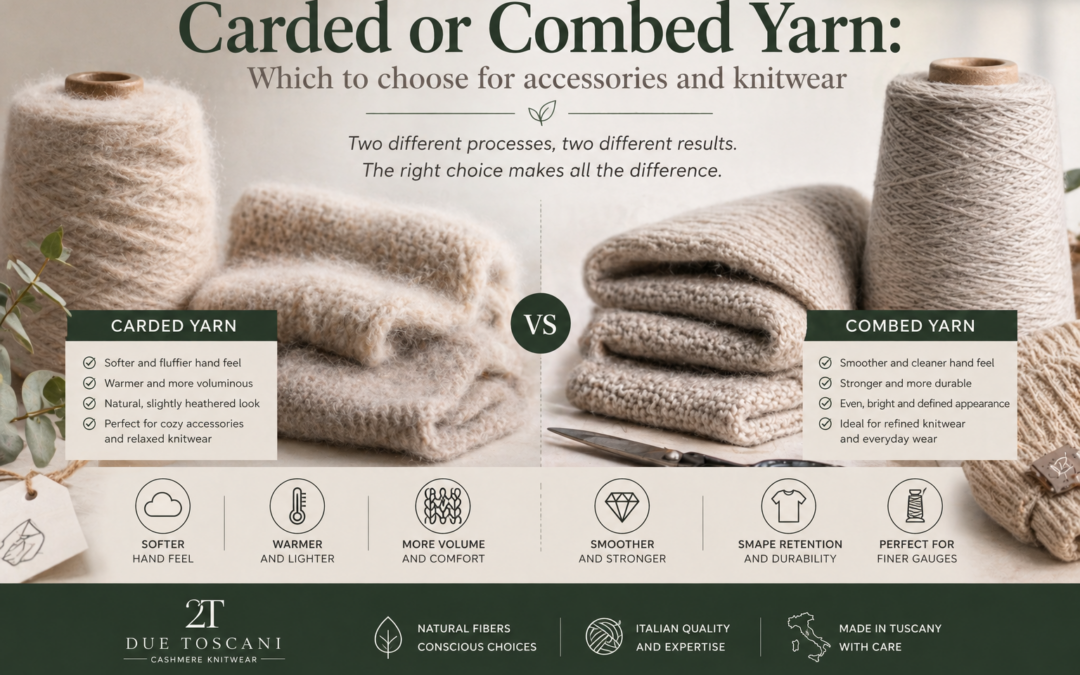
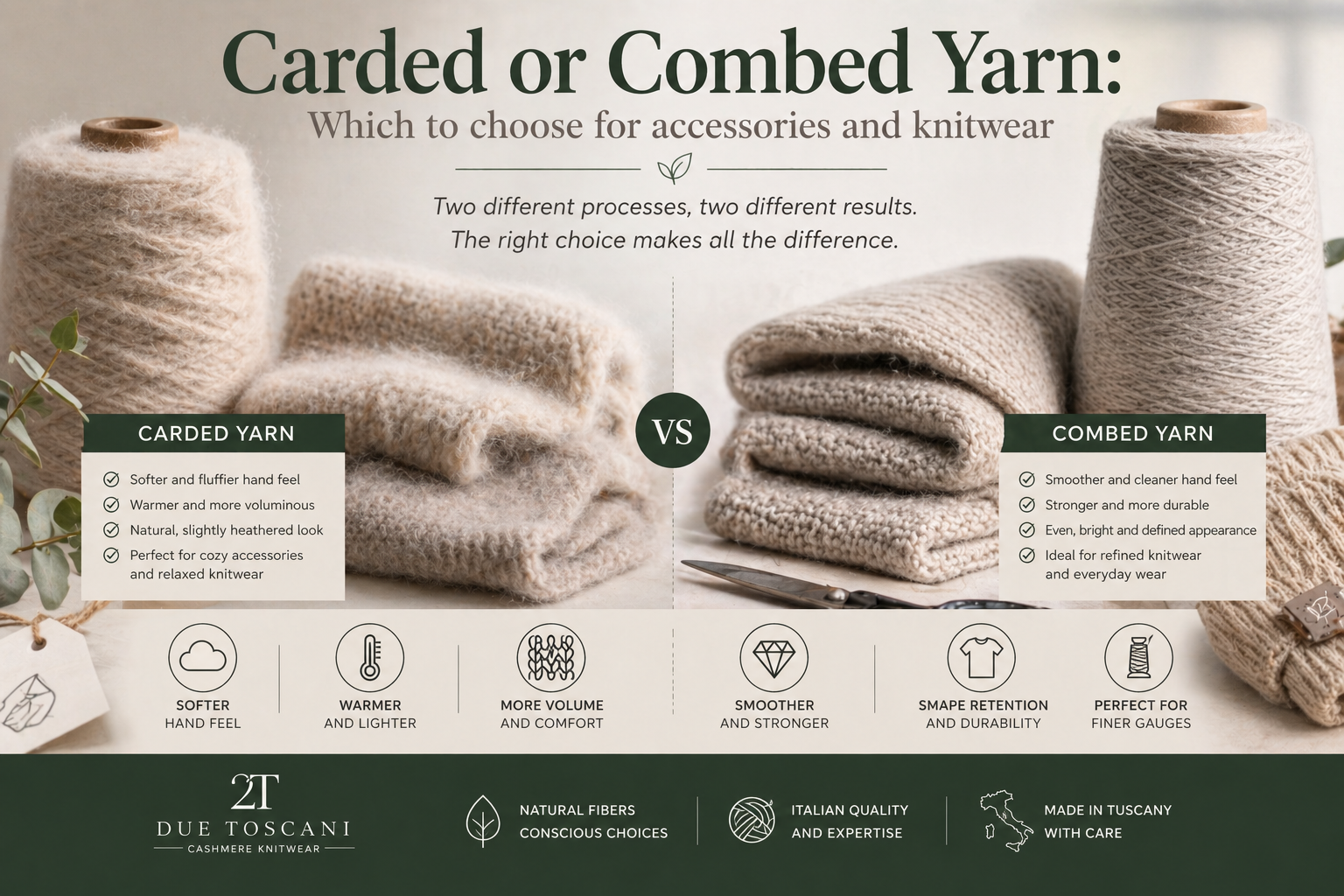
In the world of knitwear, choosing the right yarn is always a crucial step, but there is one technical distinction that more than any other influences the final result: the difference between carded and combed yarn. This is not just a visual or superficial variation, but a structural one that affects the fiber itself, the behavior during production, and the perception of the garment once worn. For a B2B client—buyer, brand, or design office—understanding this distinction means avoiding design mistakes and building collections that are coherent both aesthetically and commercially.
For Due Toscani, this choice is never random, but always linked to the type of product, its positioning, and the experience that the final customer is meant to feel.
Two Processes, Two Philosophies
Carded and combed yarns originate from two completely different processes, resulting in opposite characteristics.
Carded yarn is produced by working the fibers without fully aligning them, maintaining a more irregular, airy, and open structure. The result is a bulkier, softer, and lighter yarn, capable of trapping air within.
Combed yarn, on the other hand, undergoes a process that selects and aligns the fibers, removing the shorter ones and arranging the longer fibers in parallel. The result is a more compact, regular, and stronger yarn.
This is not a matter of better or worse, but of two fundamentally different approaches to knitwear.
Impact on Hand Feel
The difference between carded and combed yarn is immediately noticeable to the touch.
Carded yarn:
- feels softer and more “cloud-like”
- provides more warmth for the same weight
- creates an immediate sense of comfort
Combed yarn:
- feels smoother and more compact
- gives a cleaner and fresher sensation
- conveys precision and structure
Carded is emotional, combed is technical.
Impact on Appearance
Visually, the differences are equally clear.
Carded yarn:
- has a more matte, natural look
- shows slight irregularities
- tends to bloom over time
Combed yarn:
- appears more uniform and defined
- reflects light better
- maintains a more stable structure over time
The aesthetic result changes completely depending on the choice.
Behavior in Knitting
From a production standpoint, the two yarns require different approaches.
Carded yarn:
- is more delicate
- requires lower tensions
- can be less stable in very fine gauges
Combed yarn:
- is stronger
- allows for more precise knitting
- performs better on higher gauges
Combed yarn offers more control, while carded yarn offers more softness.
Which to Choose for Accessories
For accessories such as scarves, beanies, and neck warmers, the choice is often driven by comfort.
Carded yarn is particularly suitable because:
- it provides more warmth at the same weight
- creates soft, enveloping volumes
- delivers an immediate perception of quality
Combed yarn can be used when:
- a cleaner look is required
- higher resistance is needed
- more structure is desired
For emotional, comfort-driven accessories, carded yarn is often the winning choice.
Which to Choose for Knitwear
For garments, the choice becomes more strategic.
Carded yarn is ideal for:
- winter knitwear
- bulky garments
- products focused on comfort
Combed yarn is better suited for:
- fine knitwear
- elegant or formal pieces
- products requiring durability and structure
The choice depends on the positioning of the collection.
Impact on Price and Positioning
From a commercial perspective, the difference is also significant.
Carded yarn:
- allows warm garments with less material
- creates strong perceived value
- aligns with comfort and natural aesthetics
Combed yarn:
- requires more material for the same coverage
- offers greater durability
- aligns with precision and technical quality
This is not just a technical decision, but a market decision.
The Due Toscani Approach
At Due Toscani, the choice between carded and combed yarn always starts from the final product vision.
The process begins by defining:
- what the product should communicate
- who it is intended for
- how it should be perceived
Only then are the following defined:
- the yarn type
- the construction
- the knitting technique
This approach avoids mistakes and ensures consistent collections.
Choosing between carded and combed yarn is not a simple technical decision, but one that affects everything: design, price, production, and sales.
Understanding this difference means shifting from a purchasing mindset to a product development mindset.
And it is precisely in this shift that real value is created for a B2B client: in the ability to choose not just a material, but the result that material will deliver.