
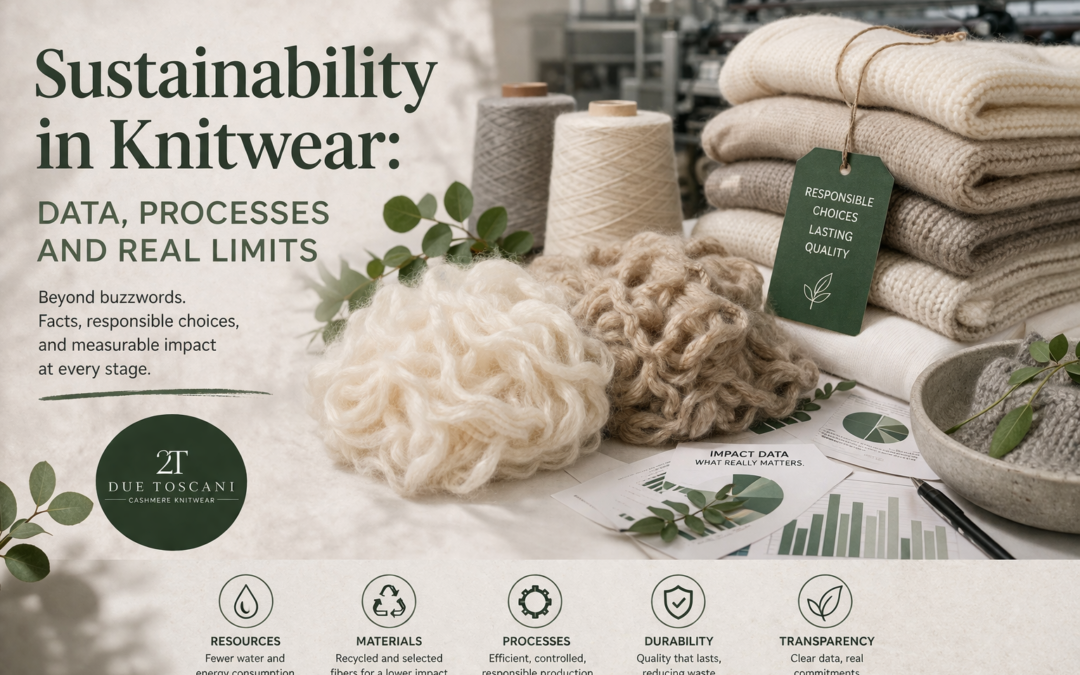
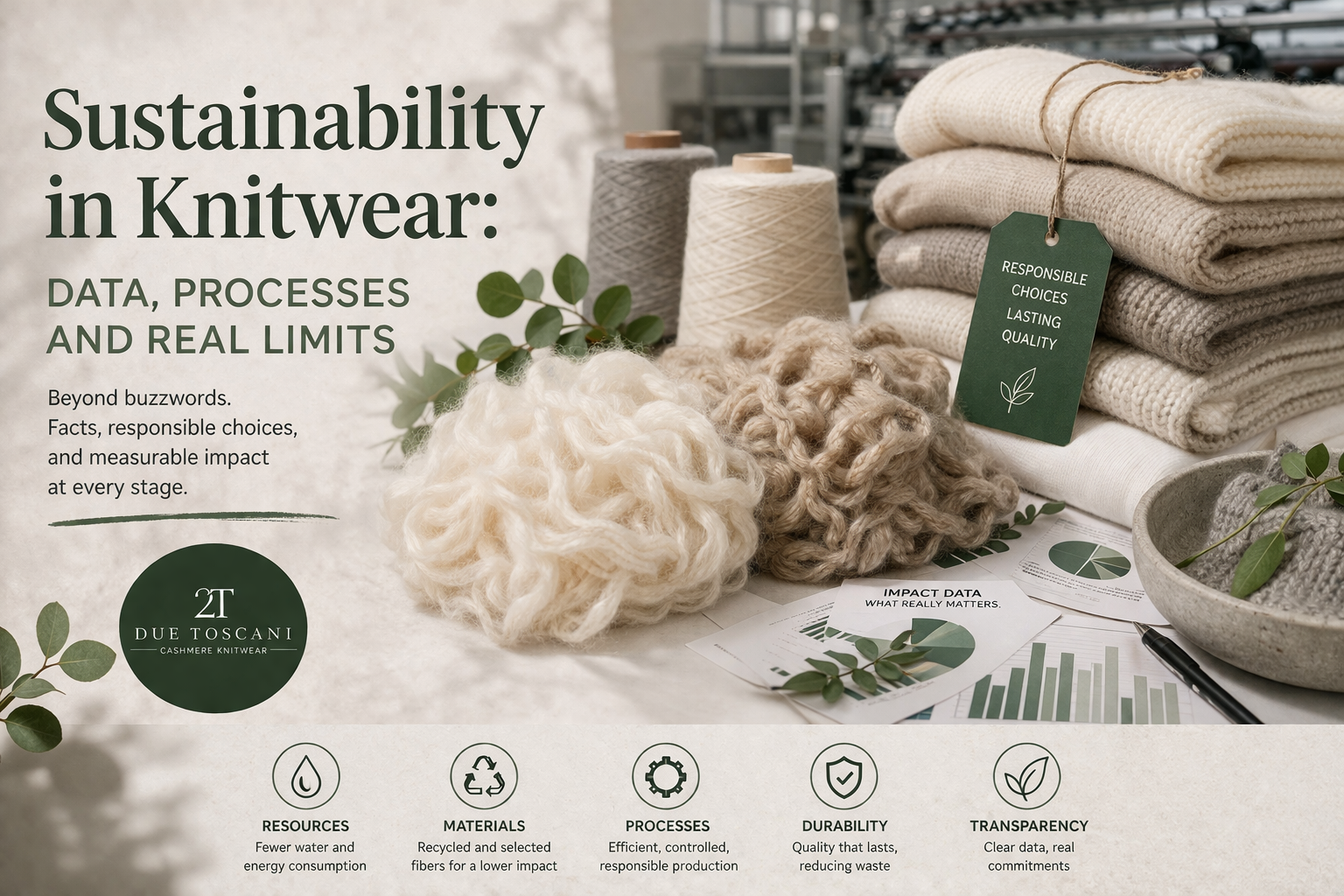
In the textile and knitwear industry, the word “sustainability” has become omnipresent, often used more as a commercial lever than as a true description of a real process. For a B2B client – buyer, brand, or design office – navigating this landscape means distinguishing between claims and facts, between marketing and production. Sustainability, when it is concrete, is not a slogan but a system of technical, industrial, and economic choices that run throughout the entire supply chain.
For Due Toscani, speaking about sustainability means starting from data, understanding processes, and above all recognizing limits. Because only what is measurable and verifiable can become real value for the market.
Beyond Marketing: What Sustainability Really Means
In knitwear, sustainability cannot be reduced to a single characteristic, such as using a “natural” or “recycled” fiber. Instead, it is the result of a system that includes:
- origin of raw materials
- production processes
- resource consumption
- product durability
- end-of-life management
A cashmere garment, for example, can be natural but not sustainable if it is produced within a long, poorly controlled, or inefficient supply chain.
The Data: What Really Matters
When we speak about concrete sustainability, only a few parameters truly matter:
- water consumption in washing and dyeing processes
- energy usage during production
- amount of waste generated
- percentage of raw materials recovered or reused
- product lifespan
In the case of recycled cashmere, one of the most significant factors is the reduction of impact related to raw materials, because production starts from an already existing fiber, avoiding new phases of breeding and collection.
The Processes: Where Sustainability Is Really Created
Real sustainability is built into processes, not labels.
In the textile district of Prato, recycling is a mechanical process that avoids the use of aggressive chemicals, reduces water consumption, and allows the recovery of high-quality fibers. In the subsequent stages, sustainability depends on the efficiency of production systems, the reduction of waste, and the optimization of processes. Another key element is the short supply chain, which reduces transport, improves control, and minimizes resource dispersion.
The Role of Product Durability
One of the most underestimated aspects of sustainability is durability.
A cashmere garment that lasts for years, maintaining its shape and quality, has a lower overall impact than a product that must be frequently replaced. This applies to both virgin and recycled cashmere.
Sustainability is not only about how you produce, but also about how long what you produce will last.
The Limits of Sustainability
Speaking seriously about sustainability also means acknowledging its limits.
No textile process has zero impact. Even recycling requires energy and processing. The quality of the raw material directly influences the final result. The market often imposes compromises between cost and sustainability.
Ignoring these aspects means oversimplifying a complex issue.
The Risk of Greenwashing
In B2B, one of the greatest risks is greenwashing, which includes:
- the use of generic terms such as eco, green, or sustainable
- lack of concrete data
- communication disconnected from actual production
For a buyer, this represents not only a reputational risk but also a commercial one.
The Due Toscani Approach
At Due Toscani, sustainability is integrated into the production process, not added afterward.
This means:
- using recycled cashmere produced internally
- consciously selecting virgin cashmere
- producing entirely in Tuscany
- maintaining direct control over production
Not everything is perfect, but everything is coherent and verifiable.
Sustainability and Commercial Value
For a B2B client, sustainability is not only an ethical choice but also a commercial opportunity.
A sustainable product, when supported by:
- real quality
- credible communication
- long-term consistency
can become a strong differentiating factor in the market.
Sustainability in knitwear is not a final destination, but an ongoing process made of improvements, adaptations, and conscious decisions.
There are no perfect solutions, but there are more transparent, more efficient, and more responsible systems.
And it is precisely in this difference that value is created, both for those who produce and for those who sell.