Twist, Ply Count and the Final Performance of Cashmere

Twist, Ply Count and the Final Performance of Cashmere
In the world of cashmere knitwear, there are technical parameters that rarely reach the final customer, yet directly determine the quality, performance, and perception of the product. Among these, yarn twist and ply count are two fundamental elements, often underestimated but essential for anyone operating in B2B. These are not minor details, but true design variables that influence the hand feel of a garment, its stability, its durability, and, just as importantly, its commercial positioning.

For Due Toscani, working with cashmere means deeply understanding these aspects and integrating them from the earliest stages of product development, because this is where the difference is created between a garment that performs well and one that creates problems over time.

What Yarn Twist Is

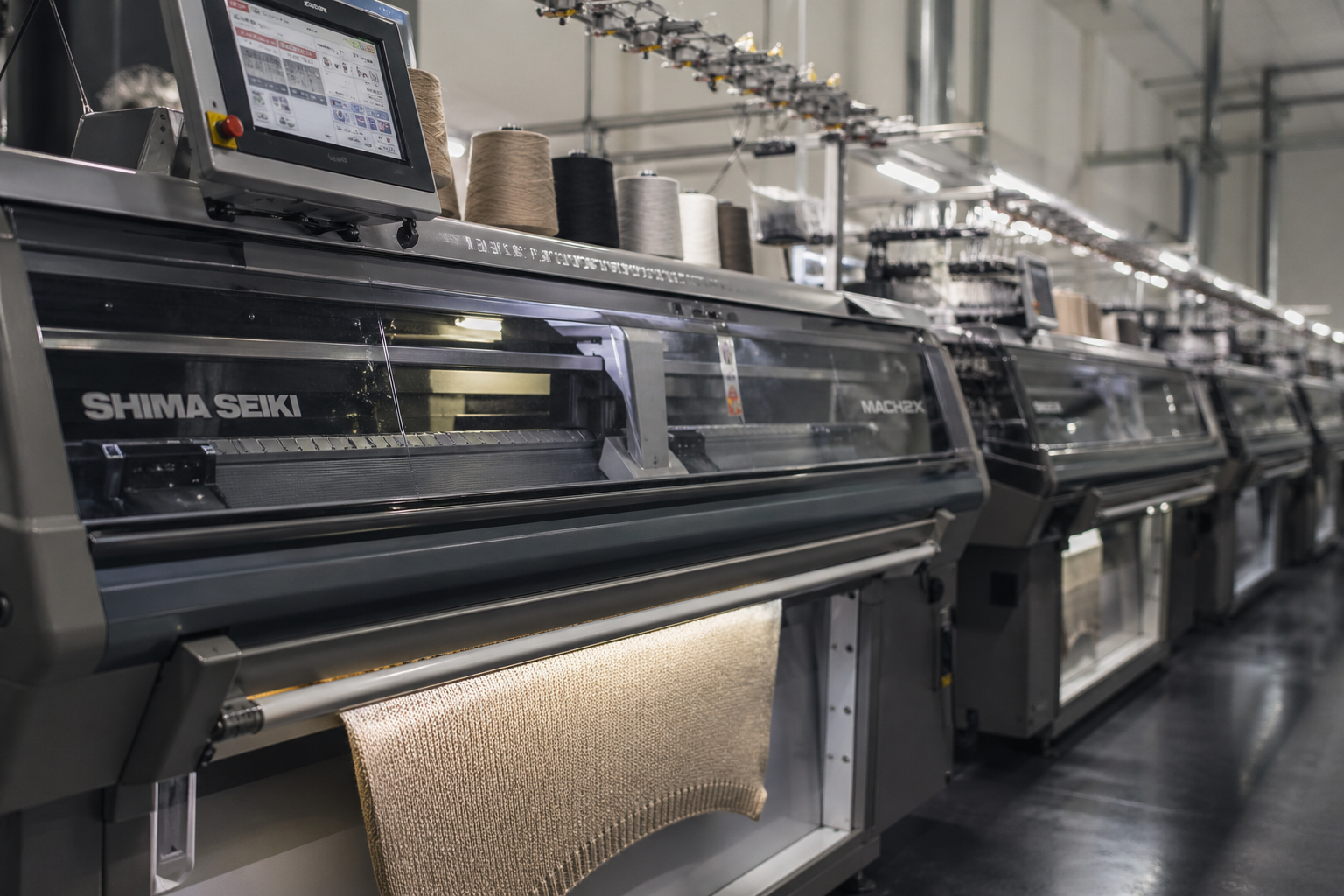
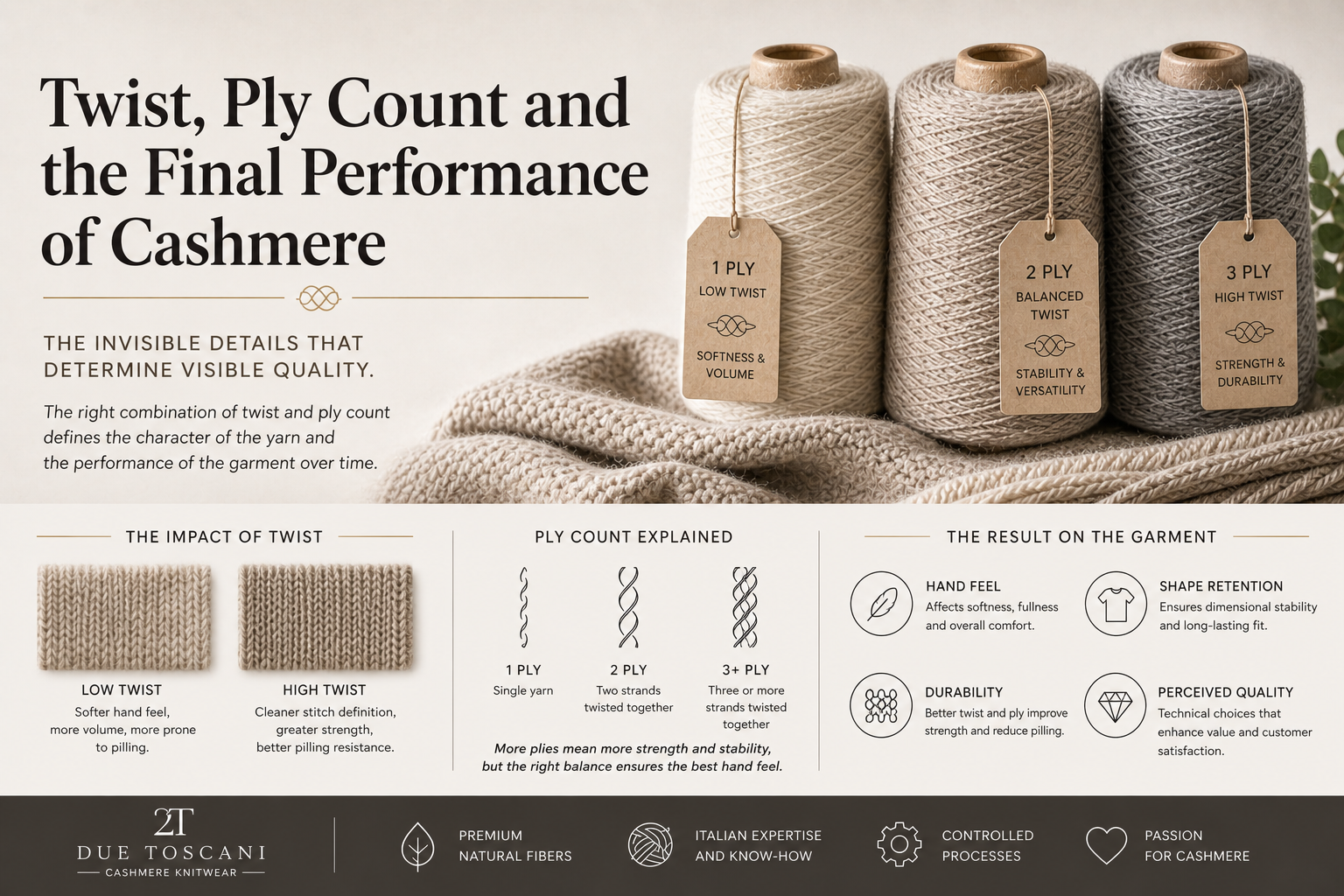
Twist is the process by which fibers are rotated around themselves to form a continuous yarn. It is what gives cohesion to the fiber, transforming a discontinuous mass into a usable thread for knitting.

However, twist is not a fixed parameter. It can vary in intensity and direction, and each variation produces concrete effects:

  • low twist results in a softer, bulkier, more open yarn
  • high twist creates a more compact, stronger, and more defined yarn

Twist is the first factor that determines the character of the yarn.

What Ply Count Really Means

When we speak of multi-ply yarns, we refer to the number of individual strands twisted together.

  • 1 ply → single yarn
  • 2 ply → two strands twisted together
  • 3 or more plies → more complex structure

In cashmere, ply count directly affects:

  • yarn strength
  • garment stability
  • long-term performance

A multi-ply yarn is not necessarily better, but it is more controlled and predictable.

Twist and Ply Count: A Balance

Twist and ply count cannot be considered separately. The final result depends on their combination.

A 2-ply yarn with balanced twist:

  • maintains softness
  • improves stability
  • reduces deformation

A single-ply yarn with low twist:

  • is extremely soft
  • but more delicate and less resistant

Quality comes from balance, not extremes.

Impact on Hand Feel

The hand feel of cashmere is one of the most important aspects for the end customer, and twist and ply count influence it directly.

  • lower twist → softer, more open feel
  • higher twist → drier, more compact feel

Similarly:

  • more plies → more structured and stable sensation
  • fewer plies → lighter and more fluid feel

The tactile perception is always the result of precise technical choices.

Impact on Durability and Pilling

One of the most critical aspects of cashmere knitwear is pilling, the formation of small fiber balls on the surface.

  • low-twist yarns tend to pill more
  • well-twisted, multi-ply yarns resist pilling better

This is because the fibers are more firmly anchored within the yarn.

A well-constructed yarn improves garment durability.

Behavior in Production

From a production perspective, twist and ply count influence:

  • yarn flow in the machine
  • stability during knitting
  • stitch definition

A yarn that is too soft may:

  • break more easily
  • create irregularities

A yarn that is too tightly twisted may:

  • lose softness
  • feel less like true cashmere

Again, the difference lies in balance.

Impact on Price

Twist and ply count also affect the final cost.

  • more plies → more processing → higher cost
  • controlled twist → more precise production → higher quality

However, the value is not just in cost, but in performance:

a well-built yarn reduces production issues, returns, and customer dissatisfaction.

The Case of Recycled Cashmere

In recycled cashmere, these aspects become even more critical.

Because the fibers are shorter, they require:

  • carefully calibrated twist
  • multi-ply structures to improve strength

Without these adjustments, the yarn would not be suitable for knitwear.

The Due Toscani Approach

At Due Toscani, twist and ply count are not standard settings, but design variables.

Each yarn is evaluated based on:

  • garment type
  • final use
  • behavior in knitting
  • performance after washing

This ensures:

  • consistency between samples and production
  • stable quality
  • long-term reliability

Twist and ply count are invisible elements, but fundamental in the construction of a cashmere product.

They determine:

  • how the garment feels
  • how long it lasts
  • how it behaves over time
  • how it is perceived by the customer

Understanding them means moving from a superficial approach to a technical and conscious vision of knitwear.

And it is precisely in this awareness that true value is created in B2B.
September seems far away, but it doesn’t wait

September seems far away, but it doesn’t wait

Every winter seems far away, until the day it suddenly arrives. And when it arrives, customers come into the store looking for exactly what they had in mind: warmth, quality, something that will last them all season. The problem is, by then, it’s too late to decide.

Knitwear isn’t created in a few days. It’s not a product you pick off a shelf and ship. It’s a process made up of precise steps, technical timing, and expert hands. It starts with the yarn, which must be selected, verified, often produced or recovered according to very rigorous criteria. Then comes the programming of the machines, the fine-tuning of the processes, the fittings. Each garment is constructed stitch by stitch, not assembled.

And then comes the real time. The time of the machines, the time for finishing, inspections, any treatments. The time needed to do things well.

Everything is concentrated between June and September. Everyone wants to produce, everyone wants to deliver, everyone wants to be ready. But production capacity, even when large, is not infinite. And above all, it isn’t flexible at the last minute.

That’s why those who arrive first work better. And receive orders first.

If the goal is to have garments ready by September, for the start of the 2026-2027 season, this is the moment when decisions make the difference. Not in a few weeks. Not “later.”

Now.

Because waiting means joining a queue. And joining a queue means accepting longer lead times, fewer choices, and less flexibility.

Those who act now have a concrete advantage: they can choose calmly, plan, build a coherent offering, and arrive in store when customers start looking, not when they’ve already purchased elsewhere.

If you’re thinking about next season, the advice is simple: plan ahead.

We’re ready to work with you to build your selection, define the garments, and plan deliveries precisely.

Write to us or reply to this email.

September is closer than it seems.

Carded vs Combed Yarn: Which to Choose for Accessories and Knitwear

Carded vs Combed Yarn: Which to Choose for Accessories and Knitwear

In the world of knitwear, choosing the right yarn is always a crucial step, but there is one technical distinction that more than any other influences the final result: the difference between carded and combed yarn. This is not just a visual or superficial variation, but a structural one that affects the fiber itself, the behavior during production, and the perception of the garment once worn. For a B2B client—buyer, brand, or design office—understanding this distinction means avoiding design mistakes and building collections that are coherent both aesthetically and commercially.

For Due Toscani, this choice is never random, but always linked to the type of product, its positioning, and the experience that the final customer is meant to feel.

Two Processes, Two Philosophies

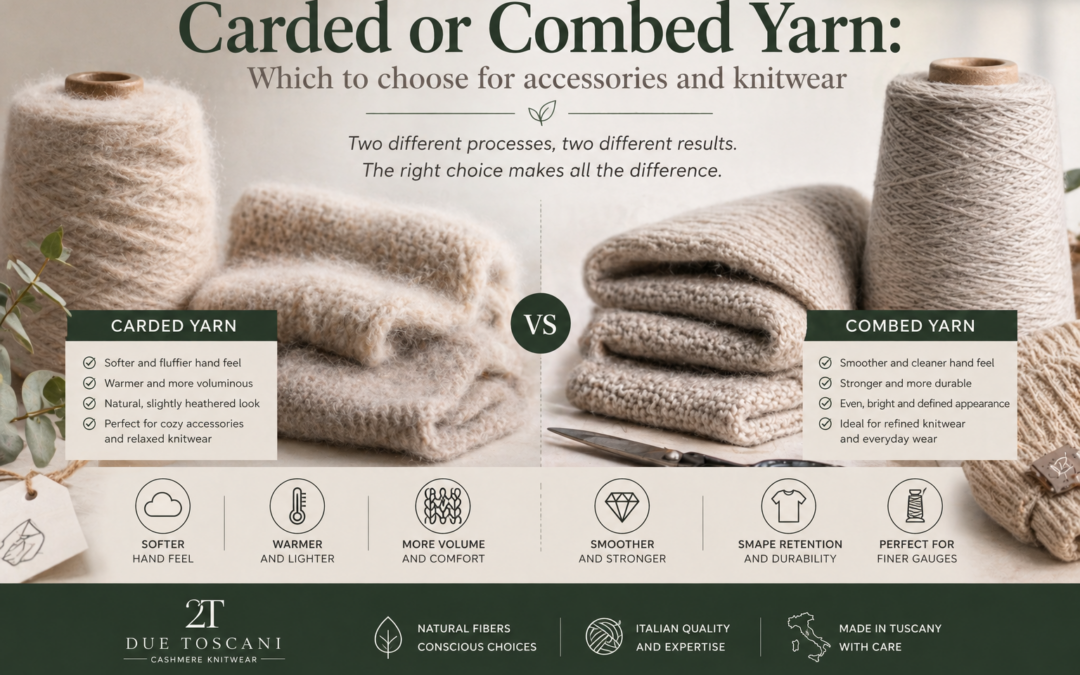
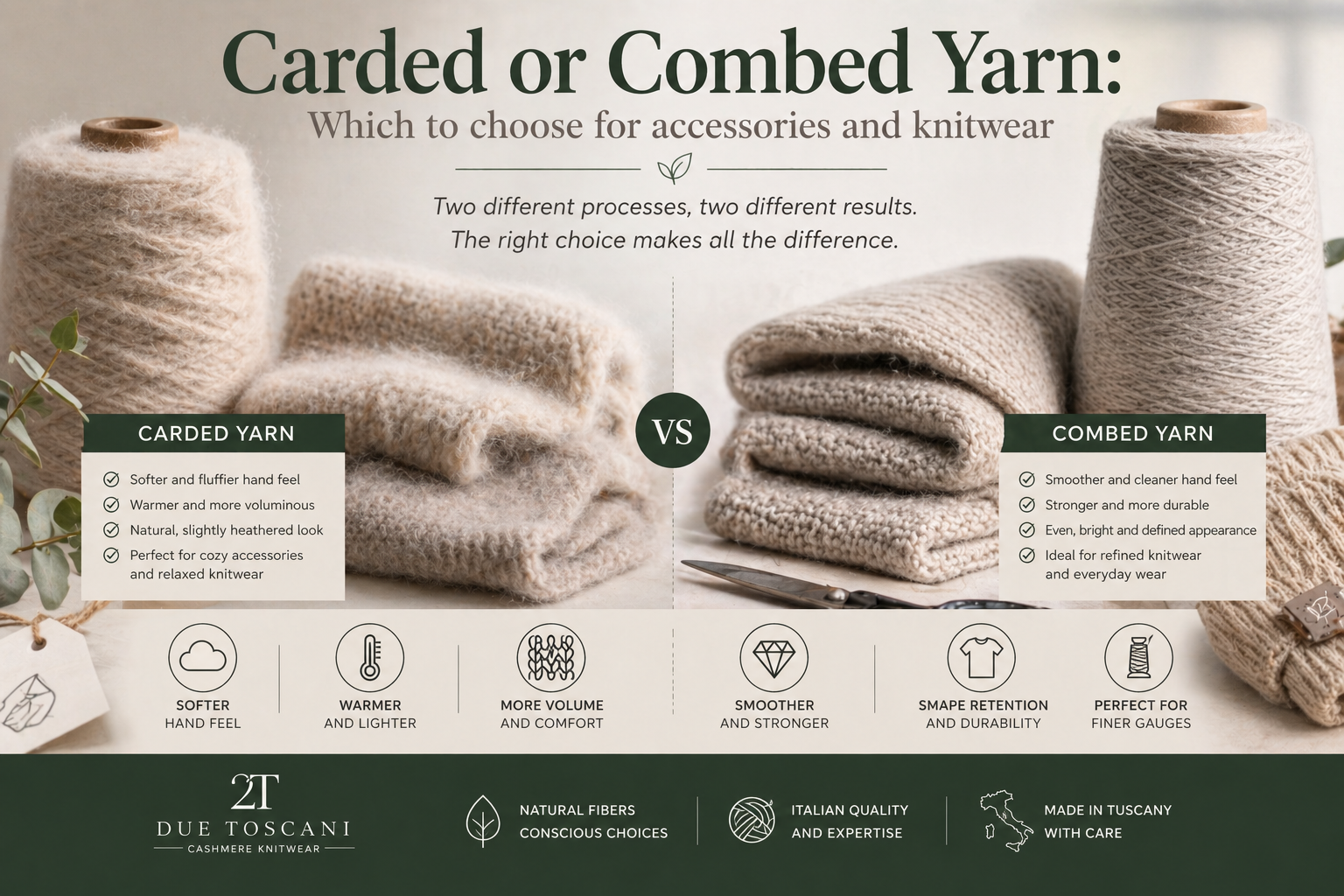
Carded and combed yarns originate from two completely different processes, resulting in opposite characteristics.

Carded yarn is produced by working the fibers without fully aligning them, maintaining a more irregular, airy, and open structure. The result is a bulkier, softer, and lighter yarn, capable of trapping air within.

Combed yarn, on the other hand, undergoes a process that selects and aligns the fibers, removing the shorter ones and arranging the longer fibers in parallel. The result is a more compact, regular, and stronger yarn.

This is not a matter of better or worse, but of two fundamentally different approaches to knitwear.

Impact on Hand Feel

The difference between carded and combed yarn is immediately noticeable to the touch.

Carded yarn:

  • feels softer and more “cloud-like”
  • provides more warmth for the same weight
  • creates an immediate sense of comfort

Combed yarn:

  • feels smoother and more compact
  • gives a cleaner and fresher sensation
  • conveys precision and structure

Carded is emotional, combed is technical.

Impact on Appearance

Visually, the differences are equally clear.

Carded yarn:

  • has a more matte, natural look
  • shows slight irregularities
  • tends to bloom over time

Combed yarn:

  • appears more uniform and defined
  • reflects light better
  • maintains a more stable structure over time

The aesthetic result changes completely depending on the choice.

Behavior in Knitting

From a production standpoint, the two yarns require different approaches.

Carded yarn:

  • is more delicate
  • requires lower tensions
  • can be less stable in very fine gauges

Combed yarn:

  • is stronger
  • allows for more precise knitting
  • performs better on higher gauges

Combed yarn offers more control, while carded yarn offers more softness.

Which to Choose for Accessories

For accessories such as scarves, beanies, and neck warmers, the choice is often driven by comfort.

Carded yarn is particularly suitable because:

  • it provides more warmth at the same weight
  • creates soft, enveloping volumes
  • delivers an immediate perception of quality

Combed yarn can be used when:

  • a cleaner look is required
  • higher resistance is needed
  • more structure is desired

For emotional, comfort-driven accessories, carded yarn is often the winning choice.

Which to Choose for Knitwear

For garments, the choice becomes more strategic.

Carded yarn is ideal for:

  • winter knitwear
  • bulky garments
  • products focused on comfort

Combed yarn is better suited for:

  • fine knitwear
  • elegant or formal pieces
  • products requiring durability and structure

The choice depends on the positioning of the collection.

Impact on Price and Positioning

From a commercial perspective, the difference is also significant.

Carded yarn:

  • allows warm garments with less material
  • creates strong perceived value
  • aligns with comfort and natural aesthetics

Combed yarn:

  • requires more material for the same coverage
  • offers greater durability
  • aligns with precision and technical quality

This is not just a technical decision, but a market decision.

The Due Toscani Approach

At Due Toscani, the choice between carded and combed yarn always starts from the final product vision.

The process begins by defining:

  • what the product should communicate
  • who it is intended for
  • how it should be perceived

Only then are the following defined:

  • the yarn type
  • the construction
  • the knitting technique

This approach avoids mistakes and ensures consistent collections.

Choosing between carded and combed yarn is not a simple technical decision, but one that affects everything: design, price, production, and sales.

Understanding this difference means shifting from a purchasing mindset to a product development mindset.

And it is precisely in this shift that real value is created for a B2B client: in the ability to choose not just a material, but the result that material will deliver.

Card vs. Cash Payments: Costs, Fees, and the Real Impact on Your Margin

Card vs. Cash Payments: Costs, Fees, and the Real Impact on Your Margin

There comes a moment in every business when you stop looking only at how much you sell… and you start asking yourself how much actually stays with you.

At the beginning, you don’t think about it. A customer walks in, buys something, pays.
Fifty euros. Everything feels normal.

If they pay in cash, the story ends there.
Those 50 euros go into the drawer and remain exactly 50 euros. No one touches them, no one reduces them. They are whole, complete, yours.

But when that same payment is made by card, something different happens.
It’s not visible. It makes no noise. It doesn’t change the immediate feeling of the sale.
And yet, something quietly separates from those 50 euros… and goes somewhere else.

It’s a percentage. Small, almost invisible.
One, two percent.
It feels like nothing.

And in a single transaction, it is nothing.

But the problem is not the single transaction.

The problem is time.

Imagine, for a moment, that those 50 euros are not just a payment, but a flow.
That they move from one transaction to another, always through electronic payments.
Each time, a small piece is taken away.

Let’s take a simple, realistic example.
A 2% fee on every transaction.

This is what happens:

Transaction Starting Amount Fee (2%) Net Received
1 €50.00 €1.00 €49.00
2 €49.00 €0.98 €48.02
3 €48.02 €0.96 €47.06
4 €47.06 €0.94 €46.12
5 €46.12 €0.92 €45.20
6 €45.20 €0.90 €44.30
7 €44.30 €0.89 €43.41
8 €43.41 €0.87 €42.54
9 €42.54 €0.85 €41.69
10 €41.69 €0.83 €40.86

After ten steps, those 50 euros are no longer 50.
They have become just over 40.

Not because someone spent more.
Not because the product changed.
But because every step left a trace.

And this is where perspective shifts.

Because in reality, those same 50 euros don’t literally move through ten transactions.
But your business performs that operation every day.
Multiple times a day.

Ten customers today.
A hundred this month.
A thousand in a year.

And each time, that small percentage repeats itself.

It’s no longer an exception.
It becomes a structure.

With cash, this doesn’t happen.
Fifty euros remain fifty euros, today and tomorrow.
No erosion. No intermediaries. No loss along the way.

With card payments, instead, you are accepting a trade-off.
More convenience for the customer.
More speed.
Often, even more sales.

But in exchange, there is a cost.

And that cost is not theoretical.
It is real, constant, and systematic.

The point is not to choose between cash and card as if it were a battle.
Today, that wouldn’t even make sense. Electronic payments are part of the game.

The point is to be aware of it.

Because what you don’t see, over time, weighs more than what you see immediately.

Every card payment is a choice.
A smart one, often necessary.
But always, inevitably, a choice that comes with a price.

And in the end, the real question is not how your customers pay.

It’s only one:

how much truly remains after every sale.

Yarn Count (Nm): How It Affects Hand Feel, Weight, and Price

Yarn Count (Nm): How It Affects Hand Feel, Weight, and Price

In the world of knitwear, few elements are as technical—and as decisive—as the yarn count, expressed as Nm. It is a value that appears on every label, often overlooked or misunderstood, yet it represents one of the most important parameters for anyone buying, developing, or producing knitwear. For a B2B client—whether a buyer, brand, or design office—truly understanding Nm is not just a technical detail, but a practical tool for making the right decisions about product, positioning, and margins.

For Due Toscani, yarn count is never an abstract number, but the starting point of product development, influencing the hand feel of a garment, its final weight, and its economic value.

What Nm Means

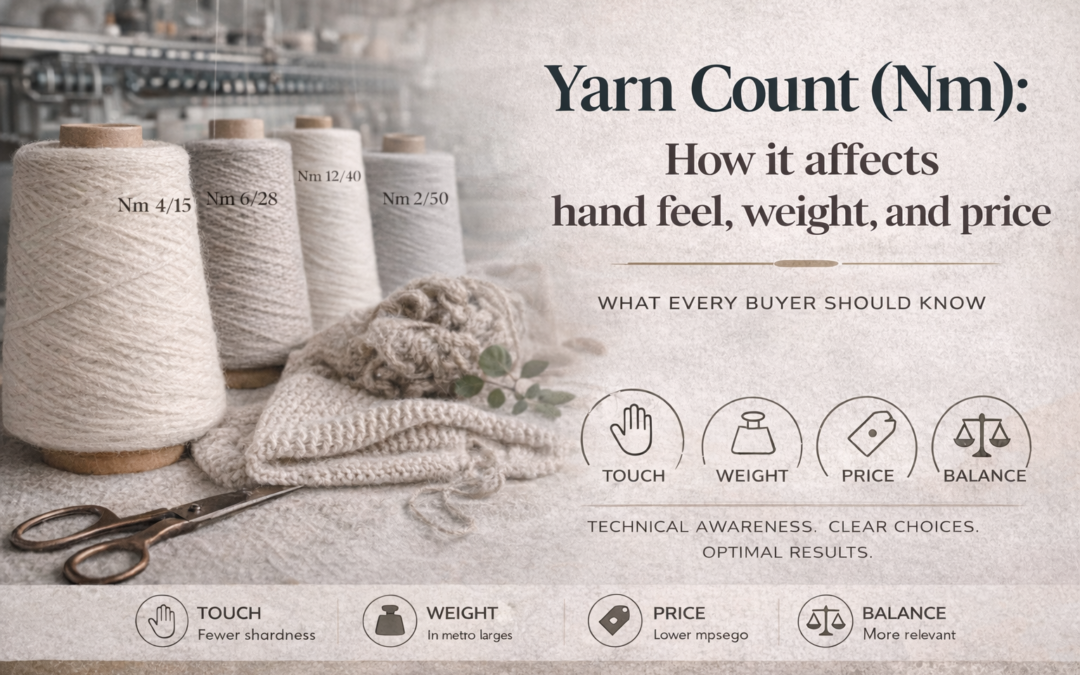
Nm, or metric count, expresses the relationship between the length and weight of a yarn. Simply put, it indicates how many meters of yarn are obtained from one gram of material.

For example:

  • a yarn labeled Nm 2/28 means two plies twisted together with a fineness equivalent to 28,000 meters per kilogram
  • a higher Nm means a finer yarn
  • a lower Nm means a thicker yarn

The higher the number, the finer and lighter the yarn becomes.

Impact on Hand Feel

Hand feel, or the tactile sensation of a garment, is one of the most immediate perceptions for the end customer. Yarn count directly influences this aspect.

A finer yarn:

  • creates a softer, more fluid hand
  • produces lighter and more refined garments
  • allows for tighter and more uniform structures

A thicker yarn:

  • results in a fuller, more structured hand
  • enhances the perception of warmth
  • creates more visible volume

There is no absolute “better” choice, only the one that aligns with the intended product.

Impact on Garment Weight

Yarn count is closely linked to the final weight of the garment.

For the same style:

  • a finer yarn requires more meters to build the garment, but results in a lighter overall weight
  • a thicker yarn uses fewer meters but more material weight

This means:

  • lightweight, transitional garments require higher Nm yarns
  • heavier, winter garments rely on lower Nm yarns

Weight is not just a physical characteristic, but also a positioning element in the market.

Impact on Price

One of the most interesting—and often less intuitive—aspects is price.

The cost of a knitwear product depends on:

  • the quantity of material used
  • the complexity of the knitting process
  • machine time

A finer yarn:

  • requires longer machine time
  • can increase production costs
  • creates a product perceived as more “luxury”

A thicker yarn:

  • reduces knitting time
  • uses more material per garment
  • leads to a different, often more accessible positioning

Price is not determined solely by the raw material, but by the balance between yarn count, production process, and perceived value.

Machine Gauge and Yarn Count

Yarn count is always linked to the gauge of the knitting machine.

  • fine yarns → high gauges
  • thicker yarns → lower gauges

An incorrect match between Nm and machine gauge can compromise:

  • garment stability
  • stitch definition
  • overall quality

For this reason, yarn count cannot be chosen in isolation, but must always be considered in relation to the production process.

Why Two Yarns with the Same Nm Can Be Different

A common misconception is that two yarns with the same Nm are equivalent.

In reality, they can differ significantly depending on:

  • fiber type (virgin or recycled)
  • fiber length
  • twist
  • spinning quality

These factors influence:

  • hand feel
  • performance
  • durability

Nm is a fundamental parameter, but not the only one.

The Due Toscani Approach

At Due Toscani, yarn count is an integral part of product development.

Every decision is made considering:

  • the type of garment
  • target price
  • yarn behavior in knitting
  • performance after washing

This approach ensures products that are not only aesthetically refined, but also consistent and repeatable over time.

Value for B2B Clients

For a buyer, understanding Nm means:

  • selecting the right yarn for each product
  • avoiding design and production errors
  • optimizing costs and margins
  • building balanced collections

It is not just a technical detail, but a strategic tool.

Yarn count is one of the most underestimated yet most decisive elements in knitwear.

It influences:

  • how the garment feels
  • how much it weighs
  • how much it costs
  • how it is perceived

Understanding it means moving from a purchasing mindset to a product development mindset.

And it is exactly in this shift that real value is created—for those who produce, and for those who sell.