The Prato Textile District: tradition, innovation, and authentic value

The Prato Textile District: tradition, innovation, and authentic value
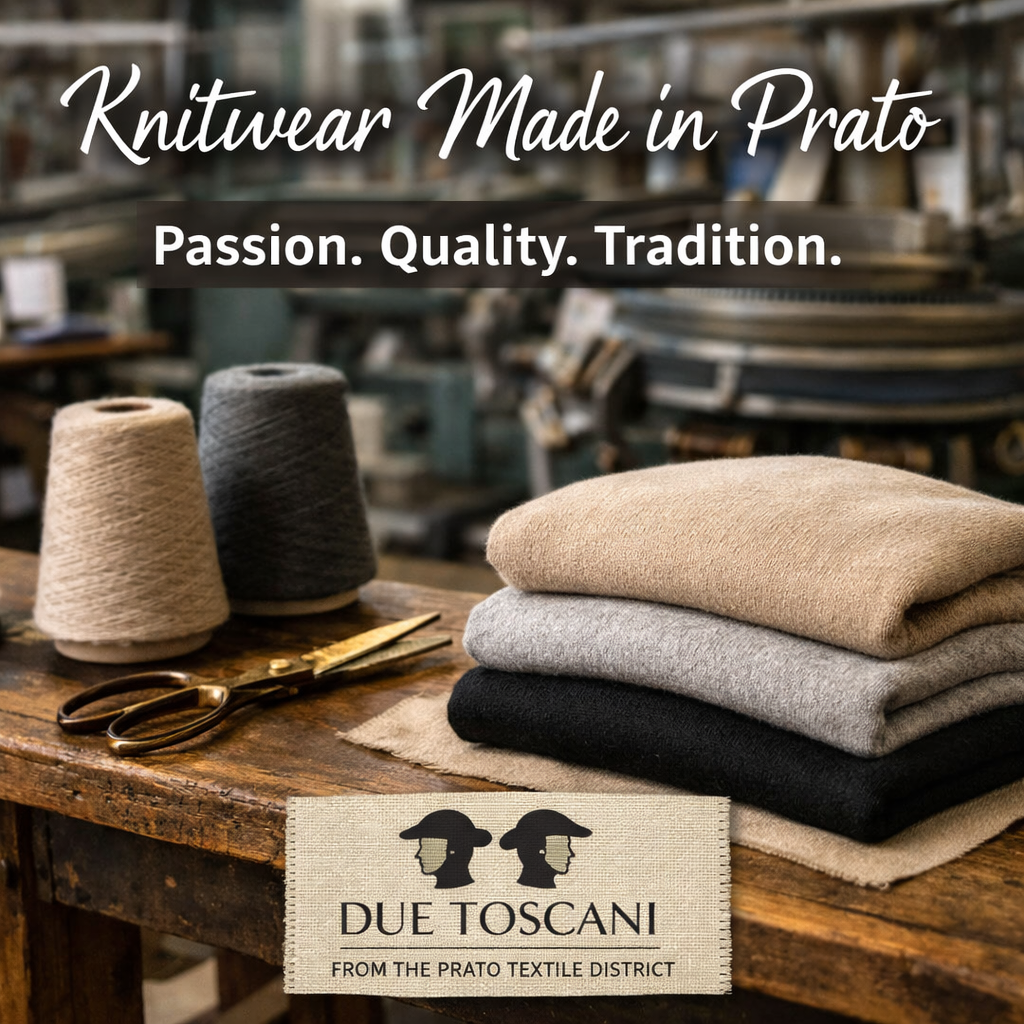
In the heart of Tuscany, between Florence and Pistoia, there is a unique place: the Prato textile district. This is not just a manufacturing area. It is a living ecosystem of skills, history, families, and knowledge passed down through generations.

For over a century, fibers have been transformed here into yarns, fabrics, and garments sold all over the world.

This is also where our story begins.

A tradition still alive today

Prato is globally known for its ability to transform raw materials into high-quality products, with a strong focus on recycling and sustainability.

The historical figure of the “rag trader” perfectly represents this mindset: recover, select, regenerate.

At Due Toscani, we are part of this tradition. We don’t just tell it — we live it every day.

What we do

We produce knitwear made of cashmere and fine fibers, entirely developed in the Prato district.

Each product is the result of:

carefully selected yarns, often regenerated
advanced knitting technologies
strict quality control throughout the process

Our collections are designed for modern retail: essential, versatile, timeless garments.

How we do it

Our process is simple, transparent, and deeply local.

Yarn selection
We use cashmere and fine fibers, often regenerated, combining quality and sustainability.
Design
We create garments that sell: modern fits, refined colors, clean lines.
Local production
We work with trusted local manufacturers using advanced knitting machines (Shima technology).
Quality control
Each piece is checked to ensure consistent high standards.

In short: we know exactly what you are selling in your store.

Why choose Due Toscani for your store
1. Products that sell

Our garments are designed to perform in retail: easy to present, easy to wear, easy to reorder.

2. Real quality

Cashmere and fine fibers made in Prato. Not just a claim — a real production fact.

3. Authentic Made in Italy

We produce locally. No outsourcing. Full control, reliability, and strong perceived value.

4. B2B flexibility

Start small, test the market, reorder quickly.

5. Short supply chain

No unnecessary intermediaries. Better margins for you.

Passion above everything

Behind every garment, there is something you cannot replicate: passion.

Passion for yarn.
Passion for knitwear.
Passion for doing things properly.

That’s the difference between a simple product and one your customer will choose to wear.

Make a different choice

Choosing Due Toscani means choosing:

authenticity
transparency
quality
a reliable partner

If you are looking for cashmere knitwear and fine fibers for your store, you are in the right place.
How a sweater is made: the knitting process

How a sweater is made: the knitting process

When we wear a cashmere or fine wool sweater, we often imagine it being sewn like a shirt or jacket. In reality, knitwear isn’t created by sewing, but by a completely different process: the garment is constructed directly with the yarn, stitch by stitch.

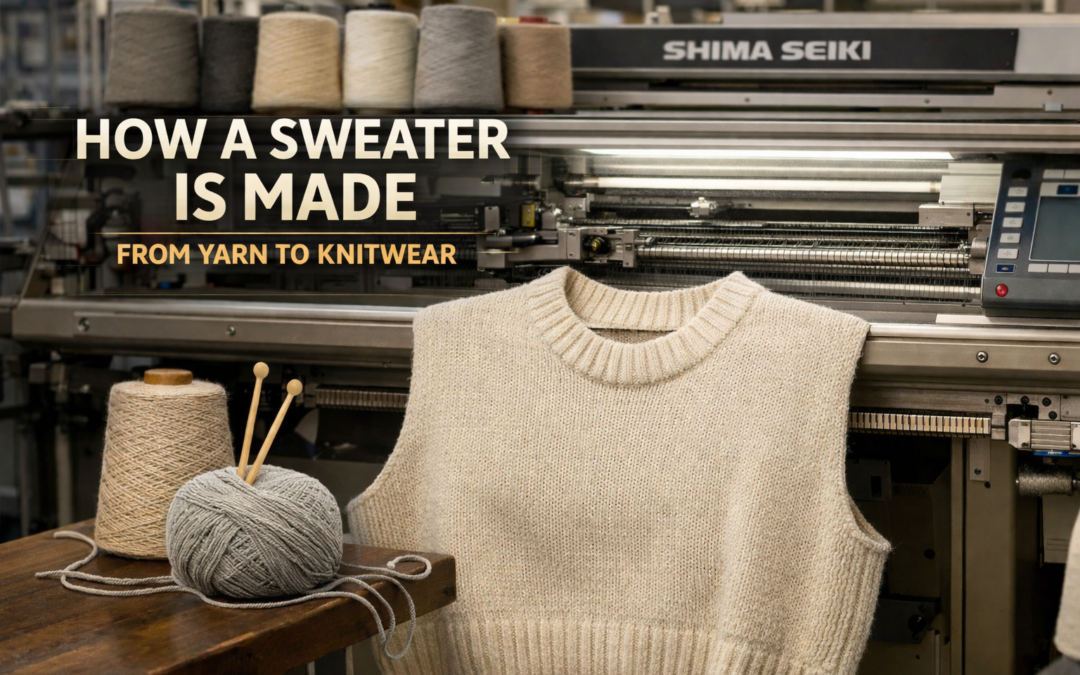
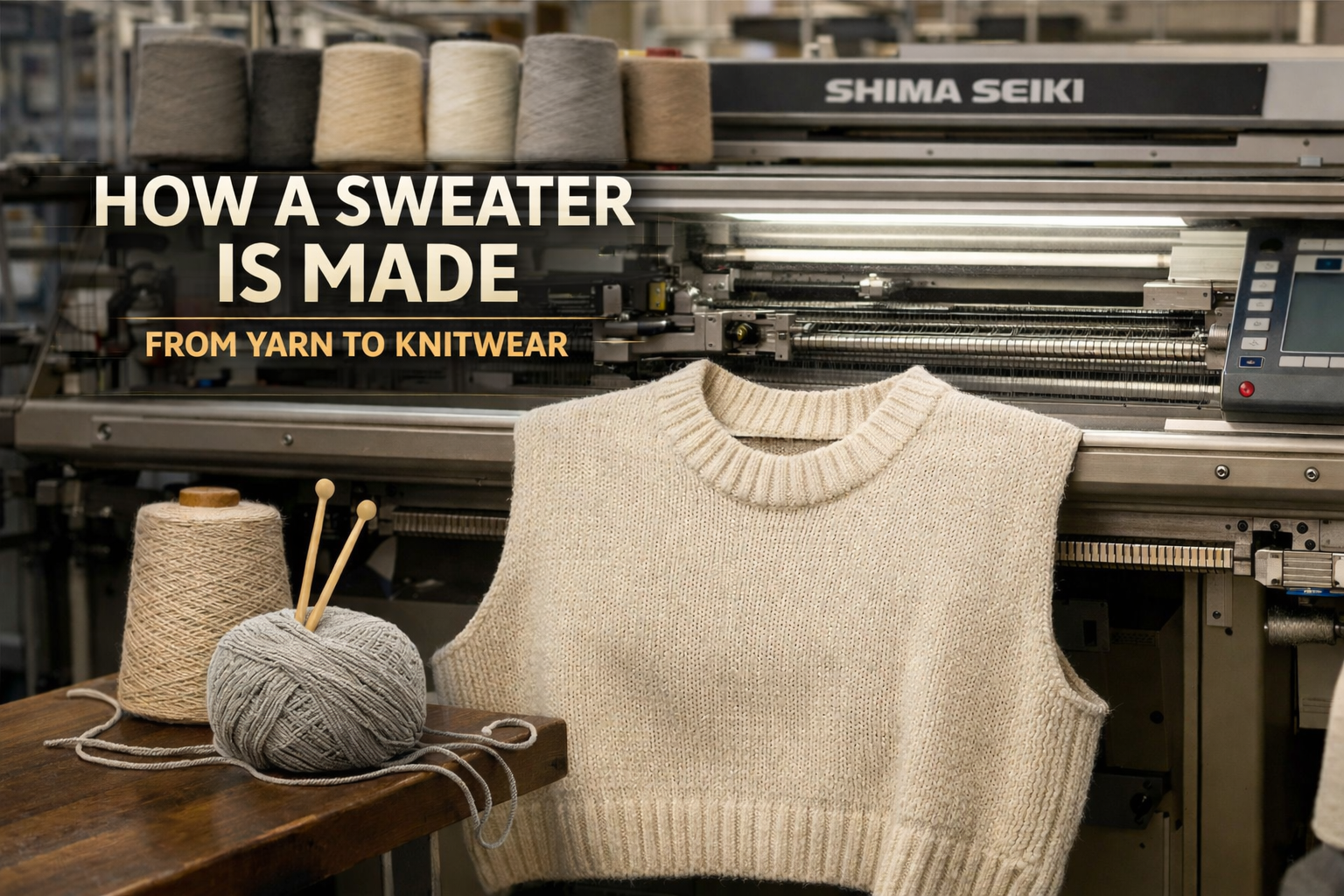
In the Prato textile district, where Due Toscani is based, much of the quality knitwear is made with electronic knitting machines, such as those produced by the Japanese company Shima Seiki, a world leader in industrial knitting technology.

Let’s see together how a sweater is created on these machines.

The first fundamental element is the yarn.

We mainly use:

cashmere

merino wool

recycled cashmere.

The yarn arrives in bobbins or cones, which are positioned behind the knitting machine.

From here, the yarn is guided through tensioners and feeders, which perfectly regulate the tension to ensure a uniform fabric.

Yarn quality is crucial:
a good yarn means more regular stitches, greater softness, and a longer-lasting garment.

Before production begins, the sweater is designed on a computer.

Special software defines:

the shape of the garment

the size

the type of stitch

any details or finishes

The program is then sent to the machine, which automatically executes the process.

The machine processes the yarn using hundreds of needles that form the stitches.

Each needle picks up the yarn and creates a stitch that intertwines with the others, forming the fabric.

This way, the various parts of the garment are created, such as:

front

back

sleeves

Each piece comes out of the machine already shaped like the pattern.

Once all the pieces are produced, they are joined together.

This process is called linking and allows the different parts of the sweater to be connected while maintaining the typical elasticity of knitwear.

The final stage is finishing.

The garment is washed, dried, and finished to achieve its final feel—the softness and appearance found in the finished product.

Knitting is a fascinating process: a simple thread creates a three-dimensional garment, constructed stitch by stitch thanks to the technology of modern machinery and the experience of the people who work in the sector.

It is this balance between technology, quality yarns, and traditional craftsmanship that allows for the creation of authentic knitwear, like that produced in Tuscany.

Cashmere Made in Italy: What It Really Means Today

Cashmere Made in Italy: What It Really Means Today

In the fashion industry, the label “Made in Italy” is everywhere.
But for B2B clients – buyers, distributors, design teams – this wording alone is no longer enough.
The real question today is: Made in Italy how? And with what real substance?

For Due Toscani, Made in Italy is not a label, but a concrete production system based on expertise, processes, and responsibility.


Has “Made in Italy” Lost Its Meaning?

Over the years, the term Made in Italy has been increasingly overused. In many cases it refers to products that:

  • are assembled in Italy using components made elsewhere
  • undergo only final processing in Italy
  • rely on long and opaque supply chains

From a legal standpoint, this may be acceptable.
From an industrial and commercial perspective, it often is not.


What Cashmere Made in Italy Should Really Include

When speaking seriously about cashmere, true Made in Italy should involve at least five key elements:

1. Yarn origin and selection

Quality starts with the yarn. True Made in Italy means:

  • Italian spinning mills or in-house yarn production
  • selection based on fineness, fiber length, and performance
  • technical knowledge of how the yarn behaves in knitting

2. Product development

Stitch patterns, gauges, and fits are never standard.
Real development happens when:

  • samples are created in-house
  • adjustments are tested directly on the machines
  • products are designed for durability, not just appearance

3. Knitwear production

Authentic Made in Italy knitwear is produced on:

  • knitting machines operated by skilled technicians
  • production timelines compatible with quality
  • direct control of tensions, stitch settings, and yield

4. Finishing and quality control

Washing, fulling, and drying strongly affect:

  • the hand feel of cashmere
  • dimensional stability
  • the final aesthetic result

These stages are not secondary: they are part of the product itself.

5. Supply chain responsibility

Today, being Made in Italy also means:

  • knowing your suppliers
  • reducing unnecessary steps
  • taking responsibility for what you produce

The Value of Made in Italy for B2B Clients

For B2B clients, genuine Made in Italy offers tangible benefits:

  • consistent quality
  • reduced production risks
  • more credible storytelling toward end customers
  • the ability to build solid, long-term collections

It is not just about image, but about industrial reliability.


The Due Toscani Approach

At Due Toscani, Made in Italy translates into:

  • production entirely based in Tuscany
  • a short, controlled supply chain
  • selected virgin cashmere and in-house recycled cashmere
  • direct dialogue with buyers and design teams

This allows us to act not only as suppliers, but as true production partners.


Today, real Made in Italy in cashmere is not about meeting the minimum legal requirement, but about telling a genuine, verifiable, and coherent production story.

And this is where the true value of long-lasting products is created.

In the next article, we will focus on the core raw material: virgin cashmere – fiber origin and selection criteria.

Who Is Due Toscani: A Short Cashmere Supply Chain, Entirely Made in Tuscany

Who Is Due Toscani: A Short Cashmere Supply Chain, Entirely Made in Tuscany

In today’s cashmere knitwear market, simply stating Made in Italy is no longer enough.
For B2B clients – boutiques, concept stores, distributors, and fashion brands – the real difference lies in the supply chain: how and where a product is made, controlled, and finished.

Due Toscani was founded with a clear vision: to create cashmere garments and accessories through a short, transparent supply chain entirely based in Tuscany, combining craftsmanship, technical expertise, and responsible production.


Rooted in the Prato Textile District

Due Toscani is deeply connected to the textile district of Prato, one of Europe’s most important historical hubs for yarn and knitwear manufacturing.
Here, more than fifty years of know-how have been passed down through hands-on experience with machines, fibers, and real production challenges.

This is not outsourced or fragmented manufacturing: every step is closely monitored, ensuring consistent quality and reliability.


New Cashmere and Recycled Cashmere: One Philosophy, Two Approaches

Due Toscani works with two complementary types of raw materials:

High-quality virgin cashmere

We use virgin cashmere sourced from the finest Italian spinning mills, selected for:

  • fiber fineness and length
  • knitting performance
  • long-term stability
  • softness and color consistency

This guarantees premium products designed for high-end markets.

In-house recycled cashmere

Alongside virgin cashmere, Due Toscani has developed its own recycled cashmere yarn production, entirely made in Tuscany.
This is not a “green marketing” exercise, but a true industrial process based on:

  • careful raw material selection
  • mechanical regeneration
  • controlled spinning
  • adapted knitting techniques for regenerated fibers

The result is a coherent, sustainable cashmere suitable for responsible collections.


In-house Production and Direct Control

One of Due Toscani’s key strengths is direct production control, covering:

  • yarn selection
  • sample development
  • electronic knitting machines
  • finishing and quality control

This structure allows high flexibility for B2B clients, both for Due Toscani collections and private label projects.


Why a Short Supply Chain Benefits B2B Clients

Working with a short supply chain means:

  • more reliable lead times
  • direct communication with the producer
  • real customization possibilities
  • consistent quality over time
  • fewer intermediaries and cost distortions

In an increasingly crowded market, production transparency becomes a commercial advantage.


Due Toscani Today

Today, Due Toscani positions itself as:

  • a producer of cashmere knitwear and accessories
  • a partner for sustainable collections
  • a technical reference for buyers and design teams
  • a structured artisan company, not an improvised one

Our goal is not simply to sell cashmere, but to build long-term B2B relationships based on expertise, trust, and continuity.

From discarded sweater to new yarn: the journey of recycled cashmere

Recycled cashmere represents one of the highlights of the Italian sustainable textile industry. It is the result of a meticulous process that transforms used knitwear into a fine yarn, ready to be used to create new, high-quality garments. Behind this result lies an extremely careful selection and processing process, requiring technical expertise, experience, and sensitivity to the material.

Here is the recycling process from old knitwear to spinning, step by step.

1-The origin of used knitwear
The raw material for recycled cashmere is discarded knitwear, collected through specialized channels, textile recovery organizations, and vintage stock dealers.
The main origins are:
Europe (especially Italy, France, and the United Kingdom): high-quality second-hand markets, where cashmere is widespread and well-preserved.
North America: garments often from premium brands, made with high-quality yarns.
Central Asia and China: 100% cashmere garments from the same areas where the Hircus goat is raised.
Not everything that arrives is suitable: it is essential to identify garments made of pure cashmere, avoiding blends with wool, silk, or synthetic fibers.

2-Manual sorting
Once they arrive at the lab, the garments are inspected by hand:
Composition check: verified through tactile experience, visual examination, and, if necessary, laboratory tests.
Sorting by color: the garments are sorted by shade (ecru, gray, beige, blue, black, fashion colors). This step is essential to reduce the need to dye the new yarn.
Sorting by quality: soft, slightly worn knits are treated differently from more compact or felted ones.

3-Fraying and fiber reduction
The selected garments are cut and removed from buttons, zippers, and seams.
Next comes the fraying process:
The knits are fed into special machines that separate the fibers, returning the fabric to a cashmere staple state.
During this phase, the fibers are worked extremely delicately to avoid excessively breaking them, maintaining their original length as much as possible.

4-Cleaning and Regeneration
The resulting fiber is washed in water (without harsh chemical processes) to remove dust, impurities, and residues.
Recycled cashmere is washed delicately and uses specific detergents, preserving the fiber’s natural properties.

5-Carding
Once dry, the fiber is carded, a mechanical process that:
Aligns the fibers in the same direction.
Removes further impurities.
Creates a uniform sliver ready for spinning.

6-Spinning
The carded sliver is spun on ring or continuous spinning machines, transforming it into a uniform yarn.
The twist is adjusted based on the final use (fine knitwear, accessories, fabrics).
At this stage, if necessary, small percentages of virgin fibers may be added to improve strength and durability.

7-Winding and quality control
The resulting yarn is wound, visually inspected, and tested for:
Count (Nm)
Tensile strength
Uniformity of twist
Any residual impurities
Only after passing all tests is the yarn ready for use in its natural state.

Technical Data Sheet – Recycled Cashmere Yarn

Fiber Origin: Discarded knitwear, mainly from Italy, France, the United Kingdom, the USA, India, Pakistan, and China
Processing Process: Manual Selection → Fraying → Washing → Carding → Spinning → Winding
Composition: 100% Recycled Cashmere
Fiber Fineness: 15–18 microns (depending on the lot and origin)
Average Fiber Length: 28–32 mm (average value for high-quality recycled cashmere)
Available Counts: Nm 2/13 (other counts upon request)
Colors: Natural colors available from selection (request color card)
Recommended Use: Machine Knitting, 7–8 gauge, accessories
Production: Made in Tuscany, Italy
Certifications: GRS (Global Recycled Standard) certification available