
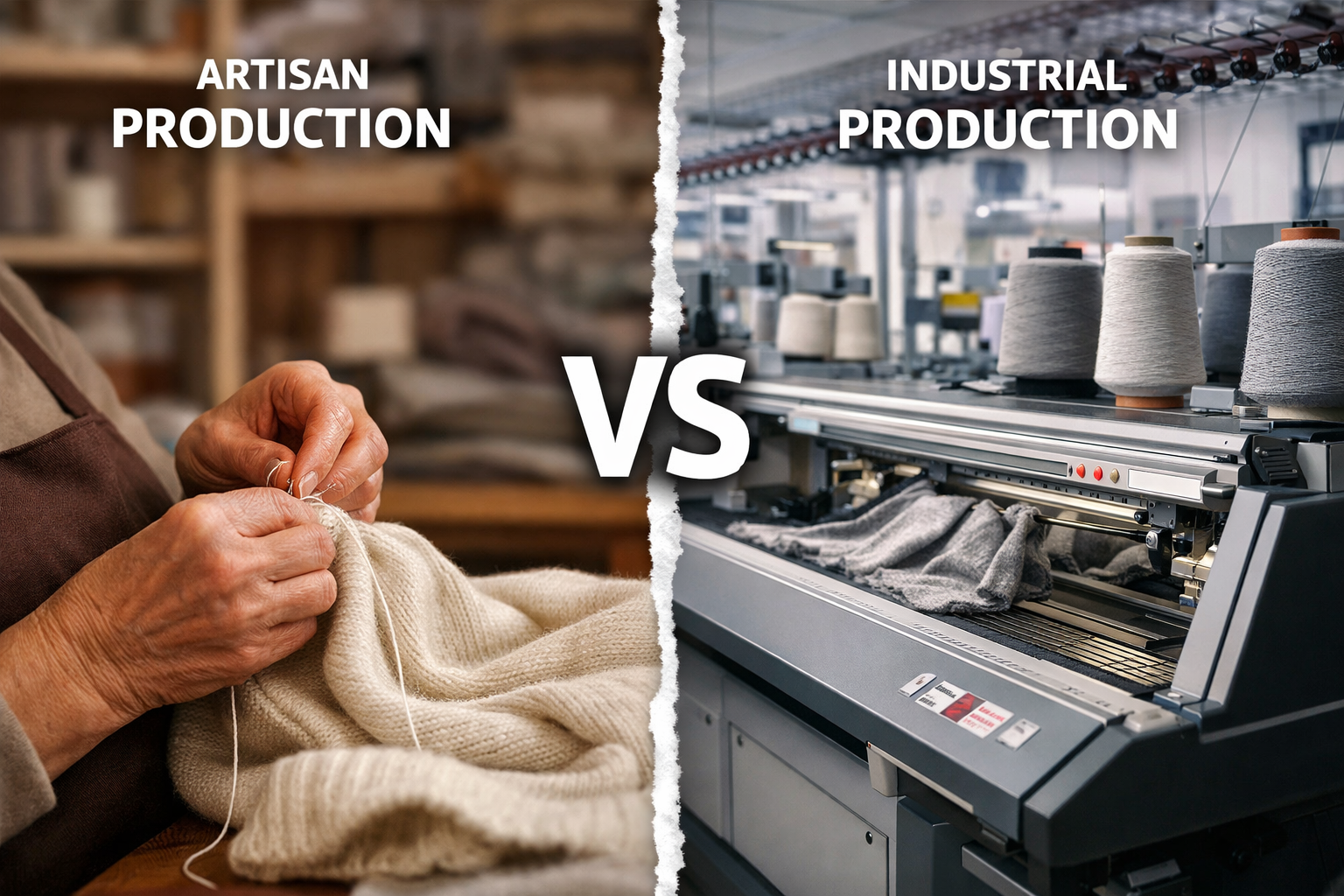
These terms are often used as marketing tools.
But for a buyer, distributor, or design team, the real question is:
which production model ensures quality, consistency, and long-term profitability?
For Due Toscani, the answer is not “artisan or industrial,” but how craftsmanship and industrial structure are combined.
What “Artisan” Really Means
True artisan production is based on:
hands-on technical skills
low-volume production
direct human intervention
attention to detail
In cashmere, this means:
manual finishing
piece-by-piece inspection
ability to adjust during production
👉 Strength: perceived quality, uniqueness, flexibility
👉 Limit: difficult to scale and standardize
What “Industrial” Really Means
Industrial production is often associated with:
large volumes
automation
standardization
cost optimization
However, in high-quality knitwear, industrial does not mean low quality.
A well-structured industrial system includes:
advanced electronic knitting machines
controlled processes
repeatable results
systematic quality control
👉 Strength: consistency, reliability, capacity
👉 Limit: rigidity if not supported by real expertise
The Real Issue: Oversimplification
The market often reduces everything to:
“artisan = high quality”
“industrial = low quality”
This is misleading.
The truth is:
there is poor artisan production
there is excellent industrial production
For a buyer, the difference lies in process control.
What B2B Buyers Should Really Evaluate
When selecting a cashmere manufacturer, focus on:
1. Production control
Who manages the process?
2. Quality consistency
Can the sample be replicated?
3. Flexibility
Can the producer adapt designs and yarns?
4. Lead times and reliability
Are timelines realistic and consistent?
5. Technical expertise
Does the producer truly understand cashmere?
Integration: The Real Value
In high-end cashmere, the most effective model combines:
industrial structure → consistency
artisan expertise → quality
This is where true competitive advantage lies.
The Due Toscani Approach
At Due Toscani, production is neither purely artisan nor purely industrial.
It is an integrated system combining:
electronic knitting machines
direct control over each stage
manual intervention where needed
deep knowledge of yarns (especially recycled cashmere)
This allows:
consistent quality
flexibility for B2B projects
real adaptation to client needs
Why This Matters
For a buyer, choosing between artisan and industrial is not aesthetic – it is strategic.
A product must:
sell
be replenished
maintain consistent standards
support brand positioning
Only a balanced production system can deliver all of this.
In cashmere, the real difference is not between artisan and industrial.
It is between:
those who control the process
and those who don’t
And that is where true value is created.