
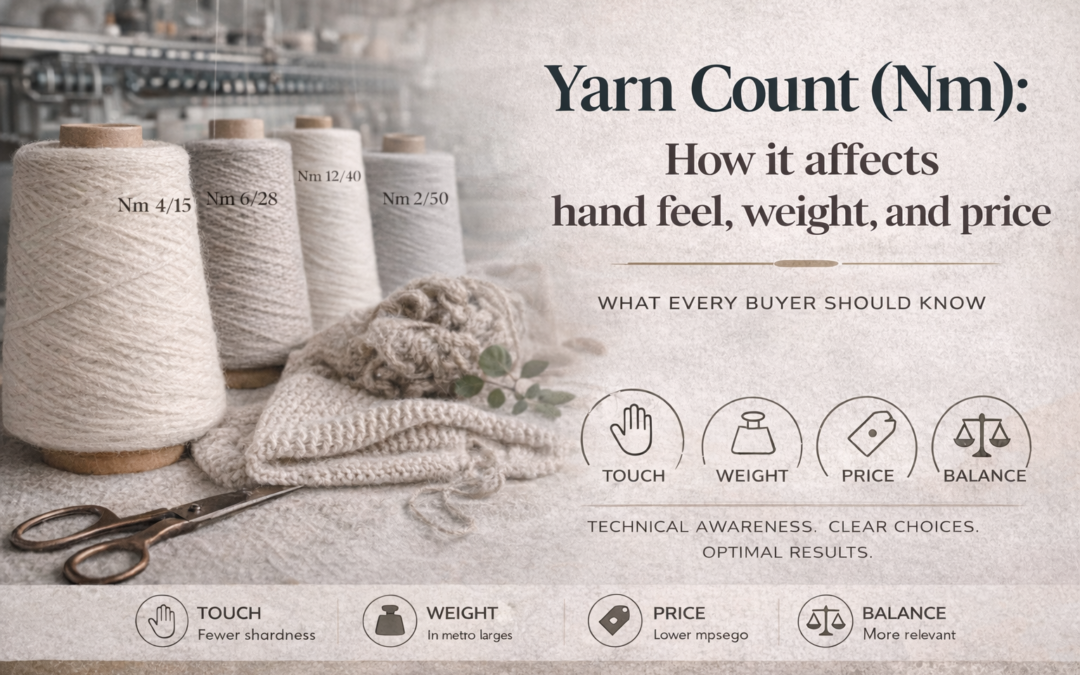
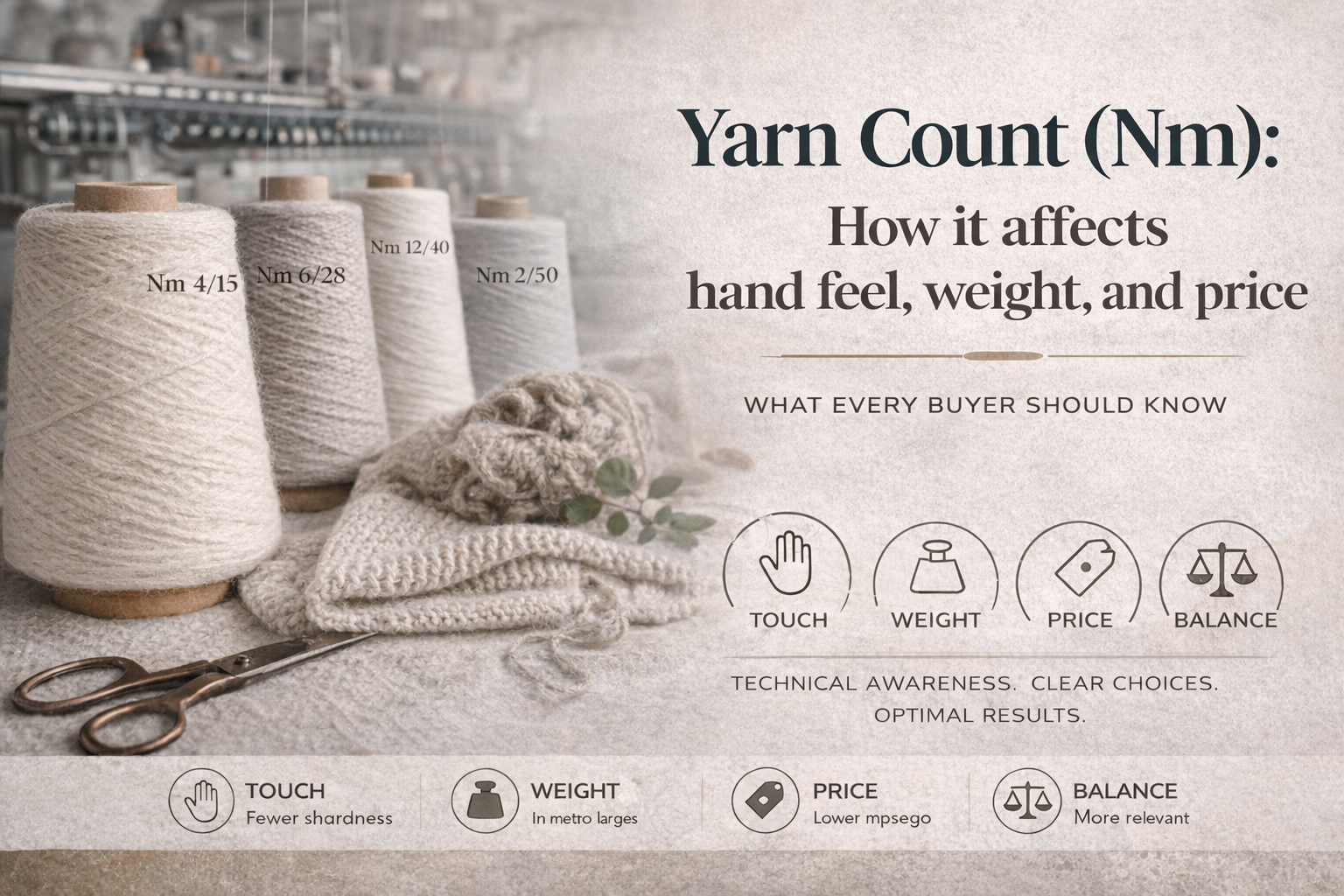
In the world of knitwear, few elements are as technical—and as decisive—as the yarn count, expressed as Nm. It is a value that appears on every label, often overlooked or misunderstood, yet it represents one of the most important parameters for anyone buying, developing, or producing knitwear. For a B2B client—whether a buyer, brand, or design office—truly understanding Nm is not just a technical detail, but a practical tool for making the right decisions about product, positioning, and margins.
For Due Toscani, yarn count is never an abstract number, but the starting point of product development, influencing the hand feel of a garment, its final weight, and its economic value.
What Nm Means
Nm, or metric count, expresses the relationship between the length and weight of a yarn. Simply put, it indicates how many meters of yarn are obtained from one gram of material.
For example:
- a yarn labeled Nm 2/28 means two plies twisted together with a fineness equivalent to 28,000 meters per kilogram
- a higher Nm means a finer yarn
- a lower Nm means a thicker yarn
The higher the number, the finer and lighter the yarn becomes.
Impact on Hand Feel
Hand feel, or the tactile sensation of a garment, is one of the most immediate perceptions for the end customer. Yarn count directly influences this aspect.
A finer yarn:
- creates a softer, more fluid hand
- produces lighter and more refined garments
- allows for tighter and more uniform structures
A thicker yarn:
- results in a fuller, more structured hand
- enhances the perception of warmth
- creates more visible volume
There is no absolute “better” choice, only the one that aligns with the intended product.
Impact on Garment Weight
Yarn count is closely linked to the final weight of the garment.
For the same style:
- a finer yarn requires more meters to build the garment, but results in a lighter overall weight
- a thicker yarn uses fewer meters but more material weight
This means:
- lightweight, transitional garments require higher Nm yarns
- heavier, winter garments rely on lower Nm yarns
Weight is not just a physical characteristic, but also a positioning element in the market.
Impact on Price
One of the most interesting—and often less intuitive—aspects is price.
The cost of a knitwear product depends on:
- the quantity of material used
- the complexity of the knitting process
- machine time
A finer yarn:
- requires longer machine time
- can increase production costs
- creates a product perceived as more “luxury”
A thicker yarn:
- reduces knitting time
- uses more material per garment
- leads to a different, often more accessible positioning
Price is not determined solely by the raw material, but by the balance between yarn count, production process, and perceived value.
Machine Gauge and Yarn Count
Yarn count is always linked to the gauge of the knitting machine.
- fine yarns → high gauges
- thicker yarns → lower gauges
An incorrect match between Nm and machine gauge can compromise:
- garment stability
- stitch definition
- overall quality
For this reason, yarn count cannot be chosen in isolation, but must always be considered in relation to the production process.
Why Two Yarns with the Same Nm Can Be Different
A common misconception is that two yarns with the same Nm are equivalent.
In reality, they can differ significantly depending on:
- fiber type (virgin or recycled)
- fiber length
- twist
- spinning quality
These factors influence:
- hand feel
- performance
- durability
Nm is a fundamental parameter, but not the only one.
The Due Toscani Approach
At Due Toscani, yarn count is an integral part of product development.
Every decision is made considering:
- the type of garment
- target price
- yarn behavior in knitting
- performance after washing
This approach ensures products that are not only aesthetically refined, but also consistent and repeatable over time.
Value for B2B Clients
For a buyer, understanding Nm means:
- selecting the right yarn for each product
- avoiding design and production errors
- optimizing costs and margins
- building balanced collections
It is not just a technical detail, but a strategic tool.
Yarn count is one of the most underestimated yet most decisive elements in knitwear.
It influences:
- how the garment feels
- how much it weighs
- how much it costs
- how it is perceived
Understanding it means moving from a purchasing mindset to a product development mindset.
And it is exactly in this shift that real value is created—for those who produce, and for those who sell.